Stride frequency
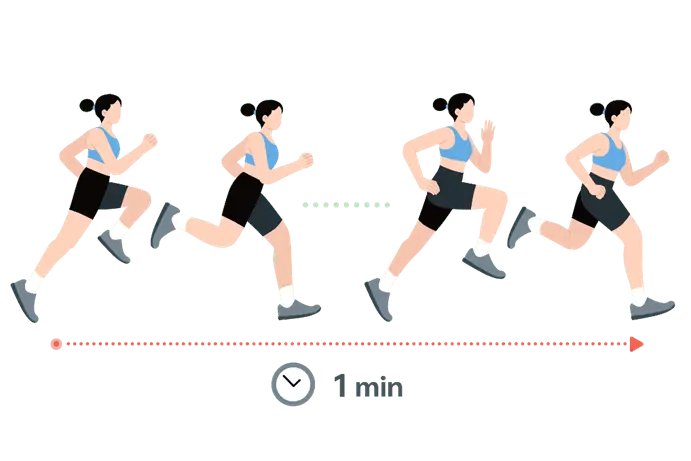
- Stride frequency refers to the number of steps taken per minute while running, and it usually increases as speed increases.
- For general runners, increasing stride frequency can help reduce the risk of sports injuries. It is recommended to maintain a stride frequency above 170 steps per minute during low to moderate pace runs. Elite runners usually have a stride frequency above 180 steps per minute, while taller runners may have slightly lower stride frequencies.
- Ways to improve stride frequency: swing your arms faster, practice rhythm with a metronome, and perform targeted drills such as high-knee drills and crossover jumps.
- Unit: steps/minute.
Stride length
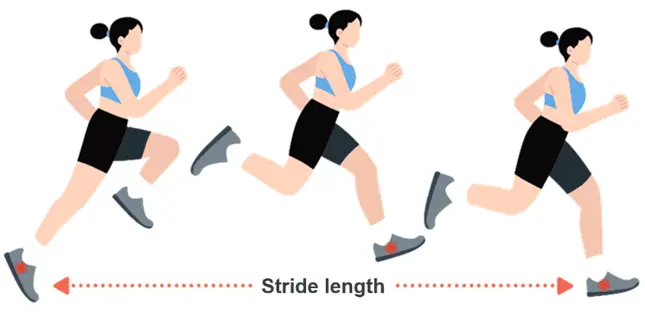
- Stride length refers to the distance covered between successive foot strikes while running, and it generally increases as running speed increases.
- For general runners, an excessively long stride can reduce running efficiency and increase the risk of injury. During low to moderate pace runs, it is recommended to focus on increasing stride frequency rather than deliberately lengthening stride.
- Ways to increase stride length: increase your leg lift and hip drive, and perform targeted drills such as lunges and mountain runs.
- Unit: meter.
GCT
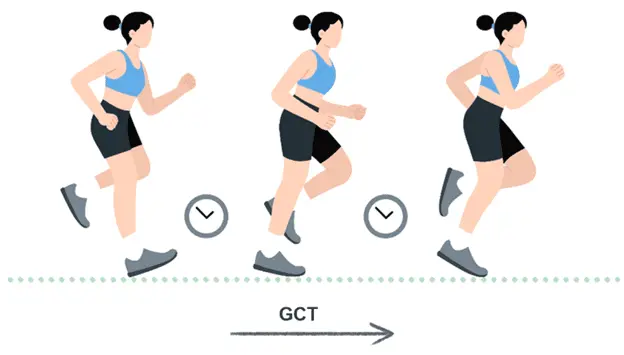
- Ground contact time (GCT) refers to the duration a single foot stays on the ground from landing to take-off while running, and it generally decreases as running speed increases.
- Shorter GCT indicates less friction with the ground and higher running efficiency. Elite runners typically have a GCT of less than 220 ms.
- Ways to reduce GCT: try forefoot or midfoot landing, actively lift the calves, and perform targeted drills such as fast in-place foot strikes and crossover jumps.
- Unit: ms.
Hang time
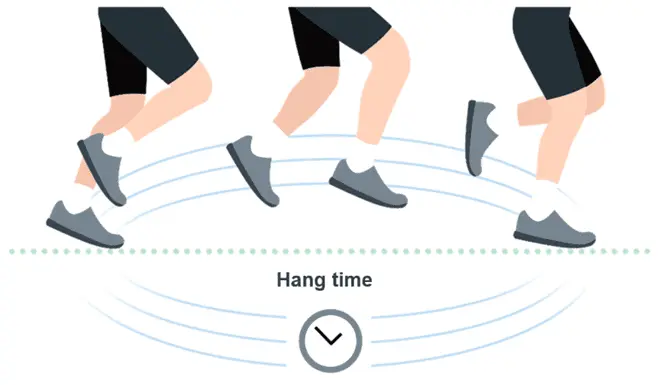
- Hang time refers to the duration during which both feet are off the ground while running.
- Hang time is closely related to stride length: at the same stride frequency, longer hang time usually results in a longer stride and higher running efficiency. If hang time is long but stride length is short, it indicates that more energy is being wasted on vertical movement, increasing fatigue. Elite runners can typically maintain a hang time of over 125 ms during high-speed running.
- Ways to optimize hang time: increase your leg lift and hip drive, and perform targeted drills such as squat jumps and alternating lunge jumps.
- Unit: ms.
Touchdown-hang ratio
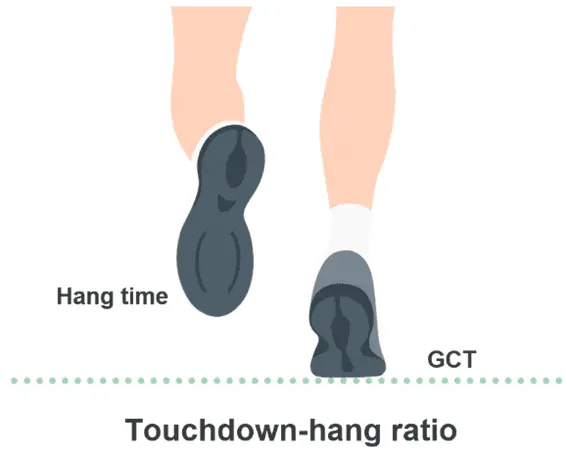
- Touchdown-hang ratio refers to the ratio of single-foot ground contact time to hang time within a running gait cycle, and it generally decreases as running speed increases.
- Running consists of a GCT and a hang period. At the same pace, reducing GCT increases the hang time available for forward propulsion, lowering the touchdown-hang ratio and making running more efficient. Elite runners can typically maintain a ratio below 2.0 during high-speed running, while 100 m sprinters may achieve a ratio as low as 0.5.
- Ways to improve the touchdown-hang ratio: increase hip mobility and push-off strength, and perform targeted drills such as single-leg knee lifts and alternating lunge jumps.
Running power
- Running power refers to the amount of work done by the body per unit of time during running. The faster the speed and the steeper the gradient, the greater the running power.
- While running, the body must overcome the effects of gravity on varying terrains, and speed alone may not accurately reflect actual intensity. Running power is calculated by taking into account speed, gradient, body weight, and other factors, complementing speed and heart rate to provide a more accurate assessment of running efficiency and intensity.
- Unit: watt.
Vertical oscillation
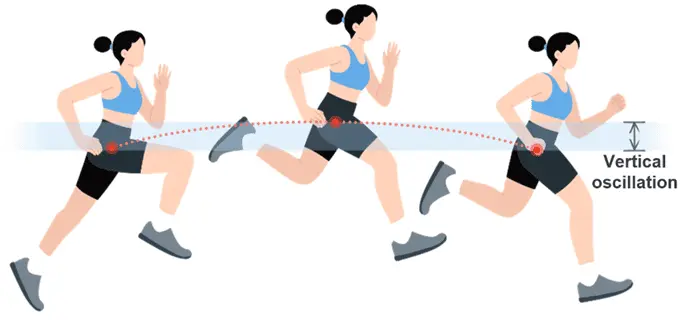
- Vertical oscillation refers to the extent of the body's up-and-down movement while running.
- Greater vertical oscillation means more energy is spent on vertical motion rather than forward propulsion. At the same pace, larger vertical oscillation is often accompanied by slower stride frequency and longer stride, which may indicate overstriding. To improve efficiency, increase stride frequency and reduce vertical movement.
- Ways to reduce vertical oscillation: increase stride frequency, minimize active push-off force, strengthen core muscles, and perform targeted drills such as planks and glute bridges.
- Unit: cm.
Vertical ratio
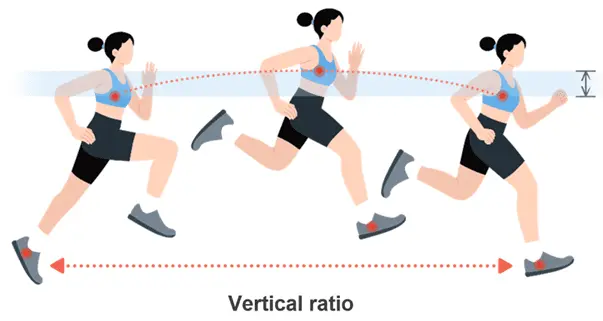
- Vertical ratio is the ratio of vertical oscillation to stride length and is used to measure horizontal running efficiency.
- A smaller vertical ratio indicates less vertical movement during running, meaning more energy is directed toward forward propulsion and running efficiency is higher.
- Ways to improve vertical ratio: while maintaining a comfortable and natural gait, try to reduce vertical oscillation and increase stride length, and perform targeted drills such as half squats and calf raises.
Pace
- Pace is a commonly used term in long-distance endurance sports and refers to the time required to complete one kilometer.
- Unit: minutes/km.
Pace zones
Running pace is divided into five zones to help runners train at different intensities. This method corresponds to the heart rate zones divided based on heart rate. However, during long-time running or high-intensity interval running, the pace zones may mismatch the heart rate zones due to differences in the body's response.
- When your running training includes pace adaptation running or high-intensity interval running, you can refer to the divided pace zones to adjust the training intensity. Pace zones vary with the running fitness levels of runners. For example, the easy run pace of a high-level runner will be faster than that of an ordinary runner.
- After a period of systematic training, your running performance and running fitness level may change. At this time, you can recalculate and set the running pace zones based on the new data to ensure that the training plan better fits your current level.
| Zone | Name | Description |
|---|---|---|
| Zone 1 | Easy run | The pace is relaxed, and you can talk easily while running. It is suitable for long-term stable running. This is the best choice for recovery run or low-intensity training. It can help you relax your muscles, promote blood circulation, and improve basic aerobic capacity and fat burning efficiency. |
| Zone 2 | Marathon | This is the ideal pace for long-distance running, with deep breathing but a steady rhythm. You feel comfortable and can sustain for a long period of time. Running in this zone can effectively improve your aerobic endurance and help you adapt to the intensity of long-distance competitions. It is an indispensable part of marathon training. |
| Zone 3 | Lactate threshold | Running in this pace zone will cause your breathing to increase but remain under control, and you feel strenuous but can persist for a while. This training can improve the efficiency of lactate clearance and delay the onset of fatigue. It is suitable for tempo run training. It is recommended that the running time be longer than the rest time, and the ratio is usually 5:1. |
| Zone 4 | Anaerobic endurance | Running in this zone will be very strenuous. You will be short of breath and your heart rate will be close to the maximum. You need a long time to recover after running. It mainly helps you enhance your body's tolerance to lactate and improve your performance in high-intensity exercise. It is an important training method to increase speed. |
| Zone 5 | High-intensity interval run | Running in this training zone is the most difficult. You will feel exhausted and even want to stop, but it can greatly improve your maximal oxygen uptake and cardiopulmonary capacity. Interval run is usually adopted, with a short sprint followed by a complete rest, and the time ratio of running to rest is 1:1. |
Running fitness levels
- Your running fitness level is a comprehensive measure of your endurance level and running efficiency.
- Your running fitness level is closely related to your race results and can help estimate your best running results at different distances. You can scientifically formulate training policies and adjust your physical condition according to your running fitness level to effectively improve your running performance.
- If you wear a watch for outdoor running, the watch can detect your heart rate, pace, and other data and score your running performance. Different scores correspond to five running fitness levels:
| Level | Description |
|---|---|
10~19.9 Beginner | Fitness level:below average Estimated capability: Able to complete a 3 km run Training suggestion: Increase the intensity and frequency of daily training while ensuring adequate rest to avoid over-training or exercise injuries. Training frequency: Once per week |
20~29.9 Junior runner | Fitness level:average Estimated capability: Able to complete a 5 km to 10 km run Training suggestion: Increase the training intensity step by step, and pay attention to proper rest and physical recovery to avoid over-training or exercise injuries. Training frequency: Twice per week |
30~39.9 Intermediate runner | Fitness level:good Estimated capability: Able to complete a half marathon or marathon Training suggestion: Maintain the current training status or gradually increase the training intensity while paying attention to proper rest and physical recovery. Training frequency: 3 times per week |
40~64.9 Advanced runner | Fitness level:excellent Estimated capability: Comparable to professional runner or high-level recreational runner Training suggestion: Maintain the current training intensity or start periodized training while paying attention to scientific nutrition supplements and proper rest. Training frequency: 4–6 times per week |
65~80.0 Elite runner | Fitness level:top Estimated capability: Close to Olympic-level athletes Training suggestion: Maintain the current training intensity while paying attention to proper rest and physical recovery. Training frequency: > 6 times per week |
Performance prediction
- If you wear a watch for outdoor running, the watch can estimate the time you need to complete a 5 km, 10 km, half marathon, or marathon by analyzing data such as heart rate and pace.